How to read a tender document without missing key clauses
How to read a tender document the way a winning bidder does, in the right order, so you make a fast bid or no-bid call before you waste a week.
A government tender document is rarely short, and it’s never written to be read quickly. You open the PDF and find forty pages of clauses, annexures and tables — most of which don’t matter to your decision, a few of which decide everything. The mistake almost everyone makes early on is reading it front to back like a contract. You don’t have time for that, and you don’t need to. Read it like a bidder instead: hunt for eight specific things in a deliberate order, and ignore the rest until you’ve decided whether this bid is even yours to win.
Here’s the order I use, and why each piece comes where it does.
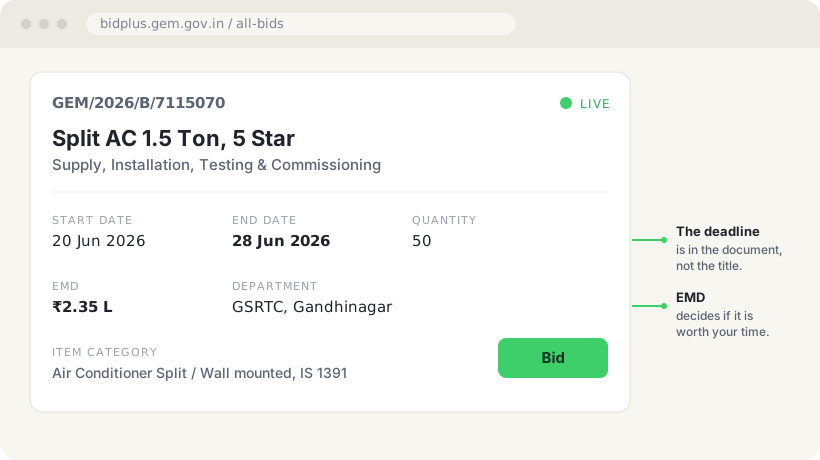
The fields that matter sit inside the bid, not in the title. The skill is finding them fast.
Start with what an NIT actually is
NIT stands for Notice Inviting Tender. It’s the formal announcement that a government buyer wants to procure something and is inviting bids. On GeM, CPPP and the various state portals, the NIT is the entry point, and it usually comes bundled with — or pointing to — the full bid document: the detailed terms, the scope, the schedule of items, and every condition you’re agreeing to if you bid.
Most tender documents follow a recognisable shape:
- A cover or summary section with the basic facts
- Eligibility and qualification criteria
- Scope of work and technical specifications
- The financial bid format, usually a BOQ or price schedule
- The general conditions of contract, which are mostly boilerplate
- The special or additional conditions, which are anything but
Once you know that shape, you can jump straight to the part you need instead of scrolling blindly.
1. The deadline and the bid-opening date
This is the very first thing to find, before you read a single technical line. Two dates matter: the last date and time for bid submission, and the bid-opening date. The submission deadline is hard. Portals close exactly on time, and a bid that is one minute late simply does not exist.
Why read this first? Because the deadline tells you whether the rest of the document is worth reading at all. If there are two days left and the tender needs an OEM authorisation you don’t have, or an EMD you can’t arrange in time, close the file now and save yourself the afternoon. Time is the resource everything else depends on — a tender found late quietly removes most of your options before you’ve made a single real decision.
2. EMD and ePBG — the money you lock up
Next, find the money you have to put up. The EMD (earnest money deposit) is what you lock up to submit the bid. The ePBG (electronic performance bank guarantee) is what you lock up after you win, for the life of the contract.
Read these early because they’re timing risks, not just costs. A bank guarantee takes days to arrange. A large ePBG held for a year is working capital gone until the contract closes. I’ve watched suppliers win a perfectly good contract and then struggle — not because the margin was thin, but because the EMD, the ePBG and the payment cycle squeezed the cash flow at the same time.
If you’re a registered MSE, check whether the EMD is exempt for you. That often changes the answer. I’ve written about all four of these terms in detail in EMD, ePBG, MII and MSE, and they’re worth knowing cold.
3. Eligibility — the gate pricing can’t open
Now the gate. The eligibility section tells you who is allowed to bid: minimum annual turnover, years in business, past experience supplying similar items or work of a similar value, sometimes specific registrations or certifications. I’ve broken the common criteria down in tender eligibility criteria explained.
Read every line carefully and honestly. This is where a bid is most often quietly impossible. If the tender wants three years of audited turnover above a number you haven’t hit, or a completion certificate for a contract of similar size you’ve never executed, you’re not eligible, and no amount of competitive pricing will change that.
Don’t talk yourself into “we’re close enough”. The evaluator won’t.
4. Scope of work and the BOQ
Once you know you’re eligible, read what they actually want. The scope of work describes the job. The BOQ (bill of quantities), or the price schedule, lists the exact items, quantities and units you’re quoting against.
Read the BOQ line by line. This is where you find out whether the tender is genuinely for what you supply, or for a bundle that includes things you don’t. A common trap: a tender that looks like your product but includes installation, commissioning, training or annual maintenance you hadn’t priced for. The BOQ is also the document you’ll eventually fill in, so a mismatch between what you sell and what they’re buying shows up here first.
5. Technical specifications and IS standards
This is the part people skim and later regret. The technical specifications define exactly what your product or service must be. Watch closely for referenced standards: an IS (Indian Standard) number, a BIS requirement, a specific grade, dimension, capacity or test report.
If the bid quotes IS 1234 or any standard, it isn’t decorative. You’ll be expected to supply a product that meets it and to attach the certificate proving so. A specification one grade above what you stock, or a standard you can’t certify against, is a no. Read the specs against your actual catalogue, not against what you think you can source in time.
6. The evaluation method: L1 versus QCBS
Now find out how they’ll choose the winner, because this changes your entire approach. The two you’ll see most:
| Method | What it means | What it rewards |
|---|---|---|
| L1 | Lowest qualifying price wins | Pure price, once you clear the technical gate |
| QCBS | Technical score and price weighted together | A strong technical bid, not just the cheapest number |
If it’s L1, your technical bid only has to clear the bar, and then it’s a price fight. If it’s QCBS, a polished technical submission can beat a cheaper competitor, so the effort you put into the technical bid isn’t wasted. Knowing which one you’re in tells you where to spend your energy before you spend any of it — I’ve covered the full process in how tenders are evaluated and awarded.
7. Delivery, consignee and timelines
Find where the goods or service have to go, and by when. The consignee location and the delivery period are easy to overlook and expensive to get wrong. A tender priced beautifully becomes a loss if the consignee is at the other end of the country and you hadn’t built freight into your number — or if the delivery window is shorter than your lead time.
8. The special and additional conditions — where the traps live
Leave time for this. The general conditions of contract are mostly standard, but the special or additional conditions are where the buyer puts the clauses specific to this tender: the inspection regime, the penalty and liquidated-damages terms, the payment schedule, an unusual warranty requirement, a mandatory document you hadn’t seen elsewhere, or a sample-submission demand with its own deadline.
I treat this section as the place where a bid that looked clean falls apart. Many of the reasons a bid gets thrown out are seeded here, in a single line nobody read until it was quoted in the rejection. It’s worth understanding why tenders get rejected so you know what these clauses can do to you.
Making the bid or no-bid call
Read in that order, and a bid or no-bid decision falls out of the document almost on its own:
- Can I meet the deadline with what the tender demands?
- Can I carry the EMD and ePBG?
- Am I actually eligible?
- Is the BOQ what I supply?
- Can I meet the specs and IS standards?
- Does the evaluation method suit my strength?
- Can I deliver to that consignee, in that window, at a price that still works?
- Is there anything in the special conditions I can’t live with?
One honest “no” anywhere in that list ends it. That’s not failure. A fast, clean no-bid is one of the most profitable decisions a small supplier makes, because it returns the week you’d have lost to a bid you were never going to win.
The whole thing only works if you’re reading the document early, with the deadline still comfortably ahead of you. A tender that reaches you with two days left doesn’t let you do any of this properly. That’s the part we built TrackTender to fix: the bids that match your category and state reach you as soon as they’re published, with the deadline and EMD already pulled out, so you start reading on day one instead of day thirteen.
Frequently asked questions
What does NIT mean in a government tender?
NIT stands for Notice Inviting Tender. It's the formal announcement that a government buyer wants to procure something and is inviting bids. On GeM, CPPP and state portals it's the entry point that bundles or points to the full bid document.
What should I read first in a tender document?
The deadline, before a single technical line. Two dates matter — the last date and time for bid submission, and the bid-opening date — and the submission deadline tells you whether the rest of the document is worth reading at all.
What is the difference between EMD and ePBG?
EMD (earnest money deposit) is what you lock up to submit the bid. ePBG (electronic performance bank guarantee) is what you lock up after you win, held for the life of the contract.
What is the difference between L1 and QCBS evaluation?
Under L1 the lowest qualifying price wins, so once you clear the technical gate it's a pure price fight. Under QCBS (Quality and Cost Based Selection) technical score and price are weighted together, so a strong technical bid can beat a cheaper competitor.
Why does the special conditions section matter most?
The general conditions of contract are mostly standard, but the special or additional conditions hold the clauses specific to that tender — inspection regimes, liquidated-damages terms, sample-submission deadlines. Many of the reasons a bid gets thrown out are seeded here, in a single line nobody read.
When is a no-bid decision the right call?
One honest no anywhere in the eight-point checklist ends it, and that's not failure. A fast, clean no-bid is one of the most profitable decisions a small supplier makes, because it returns the week you'd have lost to a bid you were never going to win.